

5 Myths about AI
No AI bubble, more expensive tokens, and other potentially unpopular claims.

There are a number of views on AI which are “common sense” or “generally accepted” that I think are wrong. Instead of beating around the bush, let me state the generally accepted claims.
There is an AI bubble
Tokens keep getting cheaper
Access to AI is universal
AI will fundamentally change economic growth
Certain skills will become more, others less important
I believe these claims are myths. Correspondingly, these are my counterclaims:
There is no bubble
Frontier tokens get more expensive
Access to frontier AI will be permission-based
The economic impact of AI will be limited
The data on “which skills survive AI” is close to worthless
Let’s discuss one by one, briefly.
There is no AI bubble
I’ve written about this before. My argument from back then hasn’t really changed. A bubble would require overcapacity and weak demand. We are seeing neither, on the contrary. I therefore do not understand the talk of the AI bubble. Of course, even a broken clock will be right twice a day, so there may one day be a massive dip. But this is like saying “a storm is coming”. Yes, a storm is coming, that’s guaranteed. But when? These predictions are useless.
I won’t make a prediction on this either. To say something like “there will be no market dip in the next 24 months” is as silly as claiming the opposite. I would simply claim the following: as long as we don’t have overcapacity and weak demand, we won’t see a collapse. Demand, I think, will stay high for a long, long time, and that’s a prediction I’d be quite confident to make. Overcapacity is harder to predict. As I wrote in the previous post, if someone tomorrow announced a frontier model which requires 100x less compute during inference, an overcapacity would temporarily appear, and a dip would be almost certain. Nobody can predict if such an event will come to pass. It hasn’t yet, and none is visible on the horizon.
Frontier tokens get more expensive
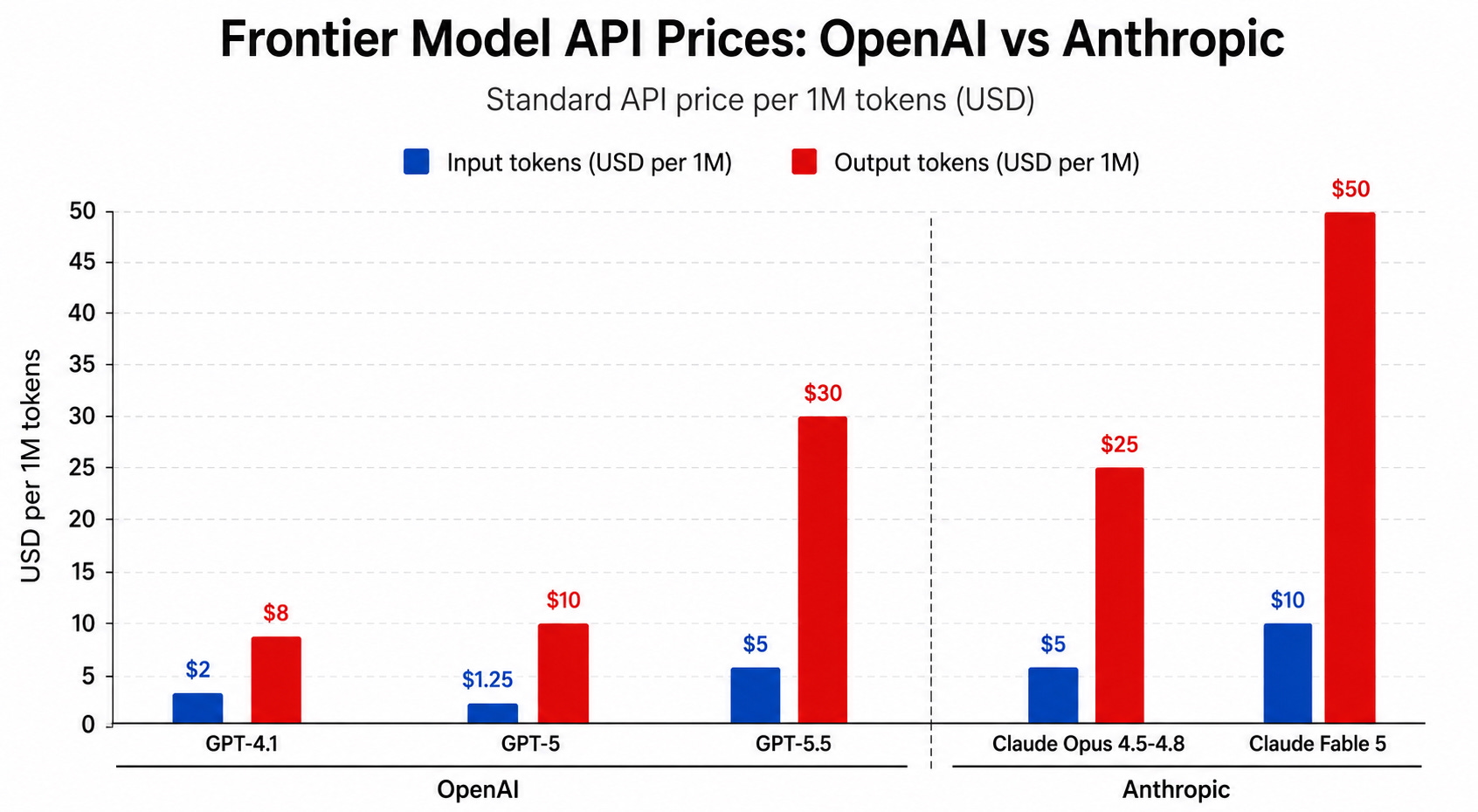
Frontier tokens have not gotten much cheaper. In fact, in many cases, the listed price per million tokens has gone up. GPT-4.1 was priced at roughly $2 per million input tokens and $8 per million output tokens, while GPT-5.5 is at roughly $5 and $30 respectively. So for premium models, tokens do not get cheaper every year.
Low-end tokens are collapsing in price, but frontier reasoning tokens are becoming a scarce, high-performance resource. And with agentic workflows consuming far more tokens, and a lack of overcapacity (see above), I expect prices to go up further. DRAM prices are exploding, which won’t help. I expect the overall cost of AI to increase.
Access to frontier AI will be permission-based
Already, GPT-5.6 and Claude Mythos are permission-based: if you are part of a special list, you get to use it. In the future, almost certainly, KYC (”Know Your Customer”) will come to AI. I’ve spoken about the implications in an exploration in The Framework, so I’ll point you there: www.theframeworkapp.com. As I mentioned in previous posts, this is where I’m now sharing most of my thinking on AI.
The app is my book, in 50 short audio lessons, plus at least weekly explorations on emerging topics.

The economic impact on AI will be limited
Another theme I touched upon: despite the massive impact of AI in some domains (such as coding), the overall economic impact will be quite limited. This might be counterintuitive, but two well-established mental models, one from biology, one from economics, explain why. In short: systems are constrained by their slowest parts, not accelerated by their fastest ones. The full argument is an exploration in the app.

Almost all skills will become more important.
Lastly, a skills-focused exploration. After digging into two big reports on AI and the future of skills (one by the WEF, one by Anthropic), I came away thinking most of the data on which skills to have in the age of AI is close to worthless. But there's one old idea that holds up surprisingly well, relating to the letter "T". This is what this exploration is about.

This might sound strange, but I’m very serious about The Framework. I strongly believe in the value of audio, and of a human voice (though I do offer an AI voice in case you happen to be allergic to mine 😅). Apart from the weekly explorations (and the book!) there will be more valuable content in the coming months.
You can check it out for free at www.theframeworkapp.com where you can listen to the first lesson on the web. Or even better, if you are already on mobile, install the app and get 5 listens for free, including the three mentioned above.